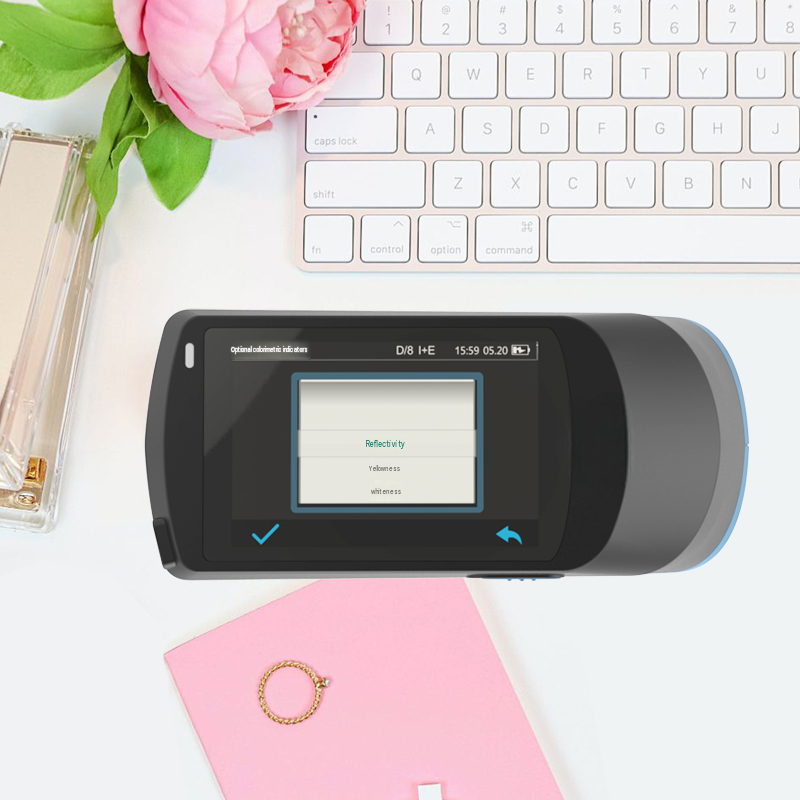
Probably, the only one product characteristic we still measure with our eyes...
Walk onto any production floor today and you'll find scales calibrated to the milligram, sensors tracking dimensional tolerances down to microns, and software logging every unit that moves through the line. Quantity, weight, size, temperature, viscosity — virtually every measurable property of a modern product is captured, digitized, and controlled by instruments built for exactly that job.
Then there's color.
Color is arguably one of the most commercially important characteristics a product has. It's the first thing a customer notices on a shelf, the signal that triggers a purchase decision before a single word of copy is read, and often the very thing that carries functional meaning — think of a color-coded warning label, a pass/fail indicator strip, or a pharmaceutical tablet whose exact shade tells a pharmacist it's the right compound. Color psychology research has long suggested that color can influence up to 80% of a shopper's snap judgment about a brand, and it's frequently cited as playing a role in the majority of purchase decisions made in the first few seconds of contact with a product (see the Color Marketing Group's research summary). Get the color wrong, and it doesn't matter how precise everything else about the product is.
And yet, despite its outsized importance, a significant share of companies — including some large, sophisticated ones — still manage color the way their grandparents did: by eye. A supervisor holds a sample up to a swatch, squints under the factory's fluorescent lights, and says "close enough." It's the one core quality parameter still routinely governed by subjective, unaided human judgment, in an era when everything else on the line is computerized.
Is it because the technology doesn't exist? No.
This is the part that should genuinely surprise people: modern, objective color measurement and management technology isn't new, experimental, or unproven. It's been commercially available and refined for decades. Digital colorimeters and spectrophotometers can capture a color's precise spectral fingerprint in seconds. Color management software can compare that reading against a target, calculate a standardized difference score, flag a batch that's drifted out of tolerance, and keep a full audit trail — all without a single human opinion entering the process. You can browse a fairly representative cross-section of exactly this kind of equipment, from portable field colorimeters to benchtop spectrophotometers, in Ametra's product catalog.
So if the tools have existed for a generation, why don't we see them everywhere? Why isn't automated, predictable, provably-accurate color the default in every factory, print shop, textile mill, and cosmetics line on the planet, the same way automated weighing and counting already is?
The real answer is twofold — and neither half is a technology problem
1. The price of entry is, frankly, unreasonable
Professional-grade color measurement instruments have historically carried price tags that make sense for a multinational with a dedicated quality lab, and make very little sense for a small manufacturer, a regional printer, or an independent coatings shop. When a piece of equipment costs several times what a comparable general-purpose measurement tool would, "let's just eyeball it for now" stops looking like a shortcut and starts looking like a rational business decision — even though it usually isn't, once you account for the cost of the mistakes it invites.
2. The learning curve is closer to a cliff
Suppose a small or mid-sized business does stretch its budget and buys a spectrophotometer. What happens next is where a lot of good intentions go to die. The operator is immediately confronted with a wall of specialist vocabulary: CIE L*a*b* coordinates, ΔE*CMC(2:1) tolerance formulas, illuminant and observer settings, and the notoriously counterintuitive phenomenon of metamerism — where two samples match perfectly under one light source and look completely different under another. None of this is explained on the box.
For someone without a color science background, this is not a gentle learning slope; it's a near-vertical cliff. Faced with a tool that demands a semester of color theory just to interpret a single number on a screen, many well-meaning teams quietly retreat to the familiar swatch-and-squint method within a few months of purchase. The instrument ends up in a drawer, and the underlying problem — unreliable, subjective color decisions — is right back where it started.
A market that has been comfortable exactly as it is
This state of affairs — expensive hardware, impenetrable jargon — has persisted for a couple of decades now, largely unchanged. It's worth asking why. We won't claim there's a smoke-filled room somewhere plotting to keep small businesses in the dark. But it doesn't take a conspiracy for an outcome to be convenient for incumbents: when the established players in color measurement talk publicly about "democratizing" color technology while their pricing and their documentation both continue to assume a corporate quality-lab budget and a trained colorist on staff, the practical effect is the same either way. High prices and steep learning curves reliably filter the market down to large accounts, and large accounts are, unsurprisingly, where the most profitable, best-supported business tends to concentrate. The specialized vocabulary of color science is real and necessary at the expert level — but it doesn't have to be the first thing a new user hits, and for years, it has been.
Analysts studying the color measurement instruments market project it growing from roughly $1.5 billion to over $2.2 billion by the end of the decade — healthy growth, but growth concentrated in the same buyer segments that could already afford to play (Research and Markets, Color Measuring Instruments Market Report). That's a market that has been expanding for years without ever truly opening up. It's overripe for a disruption that brings the same underlying capability to everyone else.
What "good enough by eye" actually costs
The financial case for closing this gap isn't theoretical. The American Society for Quality has long estimated that total quality-related costs — including the failures, rework, scrap, and returns that stem from inconsistent quality control — run to 15–20% of sales revenue at many manufacturers, with much of that cost hidden in places like expedited freight and lost line capacity rather than showing up on a single obvious line item (ASQ, Cost of Quality). Color-related mistakes — a rejected dye lot, a print run that doesn't match the brand guide, a coating batch a shade off the approved standard — are a direct, recurring contributor to that number in any color-critical industry.
Breaking the incentive down further, there are three distinct kinds of value on the table:
- Direct savings. Less rework, less scrapped material, fewer rejected shipments, and fewer expensive rush re-runs to fix a color problem that instrumental measurement would have caught before the batch ever left the line.
- Indirect operational gains. When the system — not an individual's trained eye — carries the burden of color judgment, you gain staffing flexibility. You're no longer dependent on the one veteran employee who "has the eye" for your product line, and new hires can be productive on color-sensitive tasks far sooner because the technology, not years of tacit experience, does the heavy lifting.
- Reputational stakes, in both directions. Getting color visibly wrong — an off-brand product photo, a batch of parts that doesn't match across a shipment, packaging that looks "off" next to last season's — is the kind of mistake customers notice and remember. Conversely, provably consistent color, backed by real data, is an easy, credible claim to make to retail partners and quality-conscious customers alike.
There's a workforce angle here too. Manufacturing broadly is already contending with a serious skills shortage — Deloitte and the Manufacturing Institute have projected as many as 2.1 million unfilled US manufacturing jobs by 2030 due to the skills gap (National Association of Manufacturers). Any technology that lowers the specialized-expertise bar for a critical quality function, without lowering the quality of the outcome, is solving two problems at once.
Enter Ametra: shattering both barriers at once
This is precisely the gap Ametra was built to close, and we're approaching it from both directions simultaneously.
On the hardware side, we've sourced dependable, accurate color measurement equipment from reputable manufacturers and priced it for the business that has real color problems to solve but doesn't have a corporate quality-lab budget — you can see the full range, from portable colorimeters to industrial and benchtop spectrophotometers, in our product catalog.
On the knowledge side, we're leveraging modern AI and agent technology to flatten that vertical learning curve into something close to a gentle ramp. Instead of handing a new user a raw ΔE value and a PDF glossary, the system is designed to interpret the data, explain what it means in plain language, and guide the next action — putting expert-level color decision-making within reach of a team that has never taken a color science course. You can read more about how this works on our AI-powered color management page.
The underlying technology for accurate, digital color control has been sitting on the shelf for decades, priced and packaged for a narrow slice of the market. We think it's time more of the wide range of industries that live and die by color — not just the largest players — got to use it.